Billboards in Hendersonville, NC
No Minimum Spend. No Long-Term Contracts. Just Results.
Make your brand pop in Hendersonville with digital billboard ads that are easy, flexible, and fun to launch. With Blip, you choose the screen, set your budget, and only pay when your ad plays — no contracts, no minimums, just quick visibility on your terms.
Trusted by Leading Brands


Billboard advertising
in Hendersonville has
never been easier
How much is a billboard in Hendersonville?
Why Choose Blip for Billboard Advertising in Hendersonville
Blip lets you launch in Hendersonville fast, so you can reach I-26 commuters and Four Seasons Blvd shoppers without a long setup.
With flexible budgets in Hendersonville, Blip helps you test apple-season traffic, downtown events, and airport travelers on your terms.
No contracts make Hendersonville billboard buys easy to start, pause, or scale as US 64 retail flow and commuter demand change.
Use Blip's real-time analytics in Hendersonville to see what works on I-26, then shift spend toward the strongest corridor fast.
Blip's dayparting fits Hendersonville's rhythms—run mornings for commuters, weekends for orchards, and event peaks near Downtown.
Create and update Hendersonville ads quickly with Blip's creative tools, then tailor them for airport visitors, students, and healthcare traffic.
Frequently Asked Questions About Billboard Advertising in Hendersonville
How much does a billboard cost in Hendersonville with Blip?
Where can I advertise with Blip in Hendersonville, North Carolina?
What makes billboard advertising in Hendersonville good for Blip campaigns?
When is the best time to run billboard ads in Hendersonville, North Carolina?
What kinds of audiences can I reach with billboard advertising in Hendersonville with Blip?
Do I need a contract to advertise with Blip in Hendersonville?
How fast can I launch a billboard campaign with Blip in Hendersonville?
Where can I advertise with Blip in Hendersonville?
Still have questions? Launch a campaign in minutes — no contracts, no commitments.
Start Your CampaignHendersonville Billboard Advertising Guide
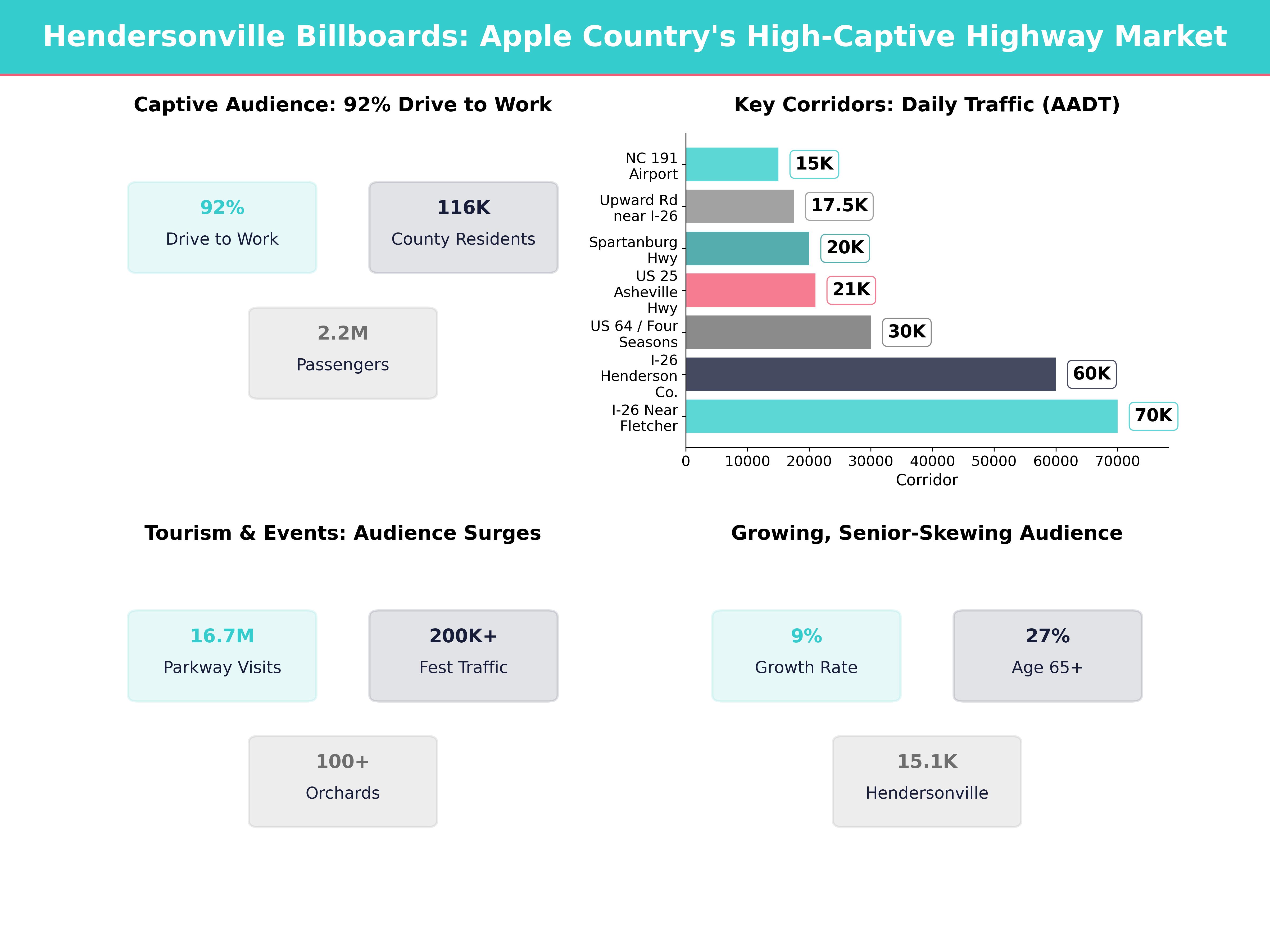
Hendersonville, North Carolina gives us a rare mix of dependable local reach and high-value visitor traffic, with more than 100 orchards and more than 2.2 million annual airport passengers feeding the market. Henderson County 116,281 residents in 2020, up from 106,740 in 2010, and the city of Hendersonville sits about 25 miles south of Asheville in one of western North Carolina’s most traveled mountain corridors. We benefit from a market where well over 90% of workers commute by car, truck, or van, which makes roadside media a natural fit for daily visibility. We also gain access to strong tourism drivers, including orchard season, downtown events, and Asheville Regional Airport, which handled more than 2.2 million passengers in 2023.
Hendersonville Market Overview for Billboard Advertising
Hendersonville’s population, growth, and trade area
When we evaluate Hendersonville, we need to think beyond the city limits. The county’s 116,281 residents are spread across Hendersonville, Fletcher, Mills River Flat Rock, and unincorporated communities that all feed the same shopping, healthcare, and commuting patterns. The county grew by 9.0% between 2010 and 2020, which tells us the market is not static.
That growth matters because Hendersonville functions as both a hometown market and a regional service center. We see local residents using Four Seasons Boulevard for errands, families moving between schools and youth activities, and visitors entering from Asheville, South Carolina, and nearby recreation areas. The city itself has roughly 15,137 residents, but the effective audience is much larger because the county is integrated with the broader western North Carolina economy.
Hendersonville’s economy and why it supports billboard demand
Henderson County is classified as a Tier 3 county by the North Carolina Department of Commerce, which places it among the state’s less economically distressed counties. That status aligns with what we see on the ground: a diversified economy that includes five major sectors—healthcare, manufacturing, agriculture, education, and tourism. Organizations like the Henderson County Partnership for Economic Development Henderson County Chamber of Commerce actively market the area as a business destination, and that helps sustain year-round advertising demand.
Healthcare alone creates a large and recurring audience. Pardee UNC Health Care 222-bed hospital, and AdventHealth Hendersonville is a 103-bed hospital. Those two systems support patient traffic, staff commuting, recruitment campaigns, specialist referrals, and service-line marketing.
Education also reinforces weekday traffic. Henderson County Public Schools operates 23 schools and serves more than 13,000 students, while Blue Ridge Community College in Flat Rock pulls students and staff from 2 counties. When we add in airport travelers, local employers, and seasonal visitors, we get a market where billboard impressions are not limited to one audience type.
What car dependence means for Hendersonville advertisers
Hendersonville is still a driving market first. Apple Country Public Transit
In practical terms, Hendersonville rewards campaigns that value repetition. A commuter who sees the same message on I-26 in the morning and on US 64 in the evening is much more likely to remember the brand, especially when the message is tied to a local need such as healthcare, dining, legal services, home repair, or retail.
Key Traffic Corridors for Digital Billboards in Hendersonville
Hendersonville’s travel patterns are concentrated into a handful of corridors, and the best billboard strategy usually starts by matching the route to the buyer journey. The North Carolina Department of Transportation traffic volume maps
I-26 through Henderson County
I-26 is the backbone of regional reach in this market. NCDOT traffic counts commonly show I-26 carrying roughly 50,000 to 70,000+ vehicles per day through Henderson County, with the airport-adjacent sections near Fletcher in the county’s busiest band at more than 70,000 AADT. This corridor links Asheville, Fletcher, Mills River
We use I-26 when we want broad awareness. Healthcare systems, colleges, attractions, regional retailers, legal services, and automotive brands all benefit here because the audience includes commuters, airport users, tourists, and cross-border travelers. If our goal is to plant a brand in memory across a wide geography, I-26 is usually the first corridor we test.
US 64 and Four Seasons Boulevard in Hendersonville
US 64, especially along Four Seasons Boulevard, is the county’s commercial workhorse. NCDOT counts on busier Hendersonville segments commonly fall in the 25,000 to 35,000 AADT range, which is exactly the kind of traffic we like for action-oriented advertising. People on this route are often already in shopping mode, meal-decision mode, or appointment mode.
This is where we place campaigns for restaurants, retail, urgent care, pharmacies, furniture, grocery-adjacent brands, and entertainment. It is also a strong corridor for event promotion because drivers are close enough to act quickly. If we want someone to make a same-day stop rather than just remember us later, US 64 is one of the best options in the county.
US 25, Asheville Highway, and Greenville Highway
US 25 captures a more local and community-based audience than I-26, but it is still busy enough to matter. Busier sections of Asheville Highway and Greenville Highway generally run around 18,000 to 24,000 AADT. The route connects northbound commuters, southbound shoppers, healthcare traffic, and residents moving between Hendersonville, Flat Rock, and the airport side of the county.
We like US 25 for businesses that need trust and familiarity more than raw scale. Community banks, family law firms, HVAC companies, dental practices, churches, senior living communities, and locally owned retailers can perform well here. The pace is often more forgiving than the interstate, so drivers have more time to absorb a name, phone number, or simple offer.
Spartanburg Highway, Upward Road, NC 191, and airport feeders
Secondary corridors are where Hendersonville gets especially interesting. NCDOT counts often place Spartanburg Highway above 20,000 AADT on commercial segments, Upward Road 15,000 to 20,000 AADT range near I-26, and key NC 191 or airport-feeder segments in the 12,000 to 18,000 AADT band. These numbers are smaller than I-26, but the audiences are often more intentional.
This cluster is ideal for workforce recruiting, industrial services, hotel promotion, event marketing, and B2B outreach. The Western North Carolina Agricultural Center 87-acre event complex near the airport, and nearby routes also serve Asheville Regional Airport, distribution traffic, and manufacturing activity in Fletcher and Mills River. When we want to reach workers, trade professionals, or visitors heading to an event, these roads can outperform bigger-name corridors.
Hendersonville Audience Segments We Can Reach
Hendersonville commuters and cross-border drivers
The first and most obvious audience is the daily driver. Because well over 90% of workers commute by car, truck, or van—roughly 92% in local commute data—billboard campaigns naturally meet people where they already spend time. We are not trying to force attention into a new channel. We are stepping into an existing behavior pattern.
Hendersonville also benefits from cross-border flow. Drivers moving between western North Carolina and Spartanburg Greenville, and the Upstate use I-26 and its feeder roads regularly. That gives us a chance to reach not only county residents, but also regional shoppers, patients, job seekers, and leisure travelers.
Hendersonville tourists, eventgoers, and leisure travelers
Tourism is one of Hendersonville’s biggest billboard advantages. Visit Hendersonville promotes a destination built around orchards, mountain scenery, downtown dining, and arts programming, and the seasonal peaks are meaningful. The North Carolina Apple Festival is a 4-day event that draws more than 200,000 visitors, and Henderson County is home to more than 100 orchards.
We also benefit from broader western North Carolina leisure traffic. The Blue Ridge Parkway logged about 16.7 million recreational visits in 2023, and many of those travelers move through the Asheville-Hendersonville corridor before choosing restaurants, lodging, orchards, breweries, or trail stops. Attractions like Flat Rock Playhouse, Downtown Hendersonville, DuPont State Recreational Forest, and nearby Brevard
Hendersonville students, parents, and school-year households
Families are another dependable segment. Henderson County Public Schools serves more than 13,000 students across 23 schools, which creates recurring traffic tied to drop-off, pickup, extracurriculars, and family spending. Blue Ridge Community College adds another layer, especially in Flat Rock and along the corridors that connect campus traffic to Hendersonville retail and housing.
This audience is valuable for healthcare, tutoring, family dining, youth programs, insurance, orthodontics, grocery, and entertainment. It is also highly calendar-driven, which means timing matters. Back-to-school, graduation season, sports periods, and spring registration windows all create clean billboard moments.
Hendersonville retirees, patients, and healthcare decision-makers
Henderson County is widely known for its older population profile, with roughly 27% of residents age 65+, and that changes what tends to resonate on outdoor media. We see strong fit for healthcare systems, specialty practices, rehab providers, hearing care, vision services, estate planning, financial services, home health, senior living, and home improvement. The presence of a 222-bed hospital at Pardee UNC Health Care 103-bed hospital at AdventHealth Hendersonville reinforces how central medical traffic is to the local economy.
This audience also values clarity and trust. Straightforward claims, recognizable local cues, and practical offers usually work better than edgy branding in this segment of the market.
Hendersonville workforce, agriculture, and trades audiences
Finally, Hendersonville gives us access to blue-collar, industrial, agricultural, and service-industry workers. Mills River and Fletcher support manufacturing and logistics traffic, while Henderson County’s apple economy creates seasonal labor and supply-chain movement. The area around the airport and the Western North Carolina Agricultural Center
We use these routes for staffing firms, trade schools, equipment dealers, building suppliers, CDL recruitment, warehouse hiring, and service contractors. In this audience, pay, shift flexibility, benefits, and location convenience tend to outperform abstract employer branding.
Ready to reach your audience in Hendersonville?
Start Your Campaign →Seasonal and Timing Opportunities in Hendersonville
Spring in Hendersonville
Spring is one of the cleanest times to advertise home and garden services in Hendersonville. Garden Jubilee in downtown Hendersonville typically features more than 200 vendors, and that creates a natural window for nurseries, landscapers, patio retailers, pest control, and home improvement brands. We also see spring demand from tax services, medical screenings, real estate, and moving-related businesses.
Because winter weather is fading and mountain driving becomes easier, residents start making discretionary trips again. That gives us more opportunities for local conversion-oriented campaigns on US 64 and US 25.
Summer in Hendersonville
Summer brings family travel, weddings, weekend getaways, and outdoor recreation. Visitors use Hendersonville as a base for orchards, breweries, scenic drives, and trail systems, and the airport helps widen the catchment. With more than 2.2 million passengers passing through Asheville Regional Airport in 2023, the broader airport corridor is not just an airline story. It is also a hotel, restaurant, rental car, attraction, and event story.
We often like to concentrate summer spend from Thursday through Sunday, especially on I-26, US 64, and airport-adjacent roads. That schedule aligns well with leisure arrivals and short-stay trips.
Fall in Hendersonville
Fall is Hendersonville’s signature season, and we should treat it that way. Apple season typically ramps up in late August and runs through October, the county’s more than 100 orchards become major trip generators, and the 4-day North Carolina Apple Festival brings in more than 200,000 visitors around Labor Day. We also get leaf-peeping traffic throughout September, October, and early November.
This is the best period for orchards, cideries, farm markets, restaurants, hotels, apparel, auto services, healthcare, and local attractions. It is also a strong time for brands outside tourism, because the roads are simply fuller. If we want maximum reach in western North Carolina, early fall is usually the first season we consider.
Holiday and winter opportunities in Hendersonville
Winter is quieter, but it is not empty. Downtown Hendersonville continues to draw shoppers, local residents still run daily errands, and healthcare needs do not slow down. We also see opportunities for senior services, tax preparation, furniture, fitness, restaurants, and event venues planning ahead for spring.
This is a good time to shift from visitor acquisition to local frequency. When tourism softens, we can use Hendersonville boards to build consistent awareness with residents who are still driving the same core corridors every week.
Hendersonville Billboard Design Tips
Use colors and imagery that feel rooted in Hendersonville
Hendersonville rewards creative that looks local. Mountain blues, orchard reds, leaf-season oranges, and clean natural greens fit the market better than overly urban or sterile visuals. If we are promoting hospitality, food, outdoor recreation, or community events, imagery that echoes orchards, ridgelines, patios, theater outings, or small-town downtown energy usually feels more authentic.
References to local experiences also help. A campaign that feels connected to Downtown Hendersonville, Flat Rock Playhouse, or the airport-and-brewery energy around Sierra Nevada Brewing Co. can read as more relevant than a one-size-fits-all regional creative.
Design for mountain driving speed and older audiences
Much of the Hendersonville audience sees outdoor ads at suburban or interstate speeds, and the county’s older demographic makes legibility even more important. We should use larger type, fewer words, and a single clear takeaway. Tiny disclaimers, dense phone numbers, or complicated calls to action are usually a mistake here.
We also need to account for weather and visibility. Western North Carolina can bring fog, rain, glare, and overcast skies, so strong contrast matters. White text on a dark field, or a bright local accent color against a clean background, usually performs better than low-contrast palettes.
Make the destination feel easy to reach
Hendersonville is an exit-driven market. People often decide whether a place feels convenient based on one quick directional cue. That means our creative should emphasize distance, area, or route familiarity whenever possible. A simple message like “Minutes from I-26,” “On Four Seasons Blvd,” or “Near Flat Rock” fits the way people navigate the county.
This matters even more for visitors. Tourists do not always know neighborhood names, but they do understand orchards, downtown, airport, and interstate references. The clearer we are about where we are, the more likely we are to convert unfamiliar drivers.
Match tone to Hendersonville’s buyer mindset
Tone should reflect the market. Trust, quality, family friendliness, health, comfort, and local credibility usually outperform snark or hard-sell urgency. For healthcare and home services, we should lean into reassurance and competence. For tourism and dining, we can be warmer, more scenic, and more experiential. For recruiting, we should lead with concrete benefits rather than slogans.
If we are targeting orchards, hospitality, construction, or service-industry hiring, bilingual creative can also make sense in selected corridors. That approach is most effective when the message stays simple and practical.
Regional Strategies Across Greater Hendersonville
Hendersonville’s retail core and downtown
When we want local action, we usually start with the Hendersonville core. Four Seasons Boulevard, nearby US 64 segments, and approaches to Downtown Hendersonville are strong for retail, dining, healthcare, entertainment, and service businesses. These placements work especially well when our goal is store visits, appointment scheduling, or event attendance.
We also like this area for frequency. Residents make repeat trips here, so even a modest campaign can generate multiple exposures per week.
Fletcher, Mills River, and the airport corridor
For broader regional reach, we move north. Fletcher, Mills River Asheville Regional Airport, the 87-acre Western North Carolina Agricultural Center
It is also a smart zone for advertisers who serve both Buncombe and Henderson counties. The airport corridor naturally overlaps the two markets.
Flat Rock and southern Henderson County
Flat Rock and surrounding southern neighborhoods tend to support arts, culture, education, retirement, and residential-service messaging. Blue Ridge Community College and Flat Rock Playhouse give the area a distinctive civic and cultural identity, and the local audience often responds well to professional, polished creative.
We use this part of the market for financial services, healthcare specialists, home remodeling, legal services, and cultural promotion. The audience here is often less impulsive and more relationship-oriented, so consistency matters.
Southbound I-26 toward South Carolina
The southbound strategy is about reach beyond Henderson County. Drivers heading toward Spartanburg Greenville create opportunities for regional attractions, destination retail, hospitals, colleges, and auto brands. If our business draws customers from both sides of the state line, interstate boards can unify that audience better than strictly local placements.
This approach also works for tourism brands that want to catch weekend visitors before they finalize plans.
US 64 west toward Brevard and recreation traffic
US 64 west is useful when we want to intersect outdoor recreation and leisure travelers. The route connects Hendersonville to Brevard DuPont State Recreational Forest. That makes it a good fit for lodging, restaurants, breweries, outdoor gear, and destination experiences.
We like this strategy most on weekends, summer travel periods, and fall foliage season, when recreational intent is highest.
Ready to reach your audience in Hendersonville?
Start Your Campaign →Using Blip Tools in Hendersonville
We can test Hendersonville corridors without overcommitting
Hendersonville is a market where small tests are useful because each corridor behaves differently. We can start with a mix of I-26, US 64, and one airport or south-county feeder, then compare which route produces the strongest response. That approach is especially valuable for advertisers who are deciding between commuter reach and visitor reach.
We can daypart around real Hendersonville travel behavior
Commute targeting matters here. Morning and late-afternoon windows are strong for I-26 and US 25 commuter traffic, while midday and weekend windows are often better for Four Seasons Boulevard, orchards, dining, and visitor attractions. During the North Carolina Apple Festival or other downtown events, we can shift spend toward the exact days when roads are fullest.
We can rotate creative by season and submarket
Hendersonville’s messaging needs change by season more than many small markets. We can run apple- and foliage-themed creative in fall, garden and home-service messages in spring, family-travel creative in summer, and healthcare or local-shopping creative in winter. We can also vary creative by geography, with broader awareness on I-26 and more direct action messaging on US 64.
We can use performance data to refine quickly
Once a campaign is live, we should watch which boards and time periods create the best lift in calls, bookings, searches, or store activity. If airport-area boards outperform downtown boards for hotel traffic, or if Four Seasons Boulevard outperforms I-26 for retail, we can redirect spend quickly instead of waiting through a rigid traditional cycle.
Getting Started with Billboard Rental in Hendersonville
We should define the Hendersonville goal before picking locations
The first step is deciding what success looks like. If we need mass awareness across western North Carolina, we should start with I-26. If we need local store visits, we should focus more on US 64 and the Hendersonville retail core. If we need recruiting, airport feeders, Spartanburg Highway, and Upward Road may be more valuable than a larger but less targeted interstate board.
We should evaluate each Hendersonville board like a local driver
When we compare boards, we should ask a few practical questions.
- We should identify whether the board faces inbound morning traffic, outbound evening traffic, or leisure traffic.
- We should measure how close the board is to our actual destination, especially if we need same-day action.
- We should consider whether the surrounding audience is mostly commuters, tourists, families, or workers.
- We should match the speed of the road to the complexity of the message, because interstate creative and Four Seasons Boulevard creative do not need to do the same job.
We can launch faster than with a traditional Hendersonville billboard buy
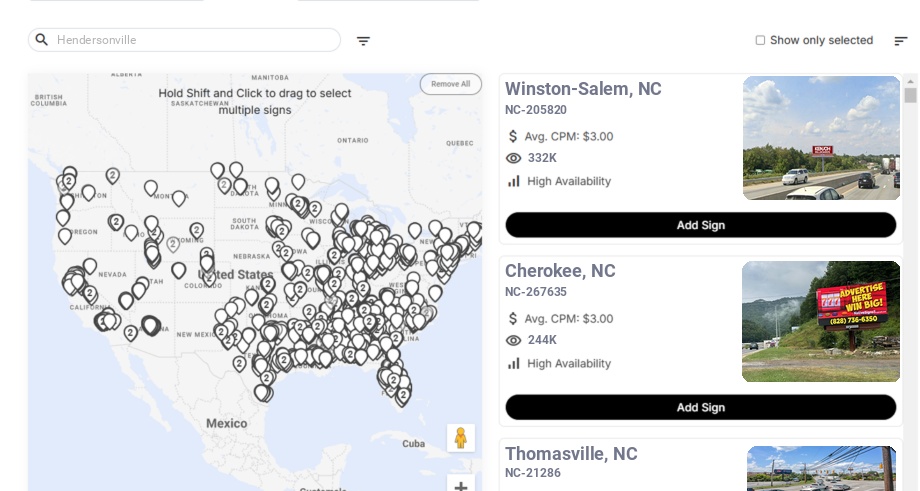
Traditional billboard buying often involves fixed packages, longer lead times, and less flexibility once the campaign starts. With Blip, we can move more like a performance marketer. We can choose Hendersonville-area digital boards from a map, launch on a schedule that matches local traffic behavior, and make adjustments as conditions change.
That flexibility matters in a market with strong seasonal swings. If apple-season traffic spikes, if an event weekend looks especially strong, or if one corridor clearly outperforms another, we can respond quickly.
We should measure more than impressions after launch
After the first flight, we should look at branded search lift, calls, appointment requests, promo-code use, website visits, and store traffic. We should also pay attention to directional patterns. A board may perform better not because the location is closer, but because it reaches drivers before they make a decision.
For many Hendersonville advertisers, the best next step is a 2- to 4-week test across 2 or 3 corridors. That gives us enough data to see whether our best audience is on I-26, Four Seasons Boulevard, or one of the airport and workforce routes. Once we know that, we can scale the winners and keep the campaign aligned with how Henderson County actually moves.